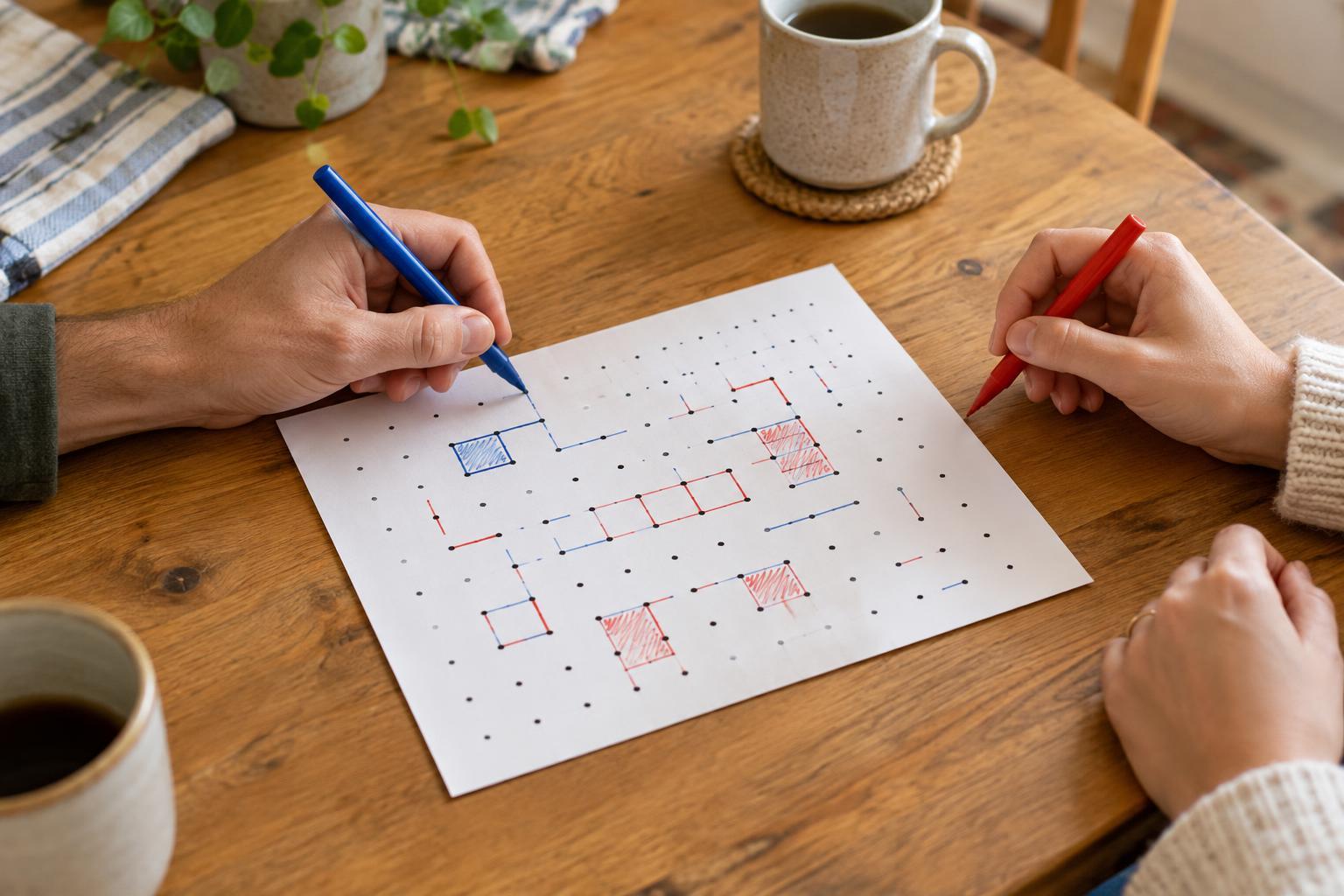
Set up a game and learn the turn rule
Draw a square grid of evenly spaced dots. A grid with five dots across and five down makes 16 possible boxes and is a comfortable size for two players learning the game. Take turns drawing one horizontal or vertical line between neighboring dots. Lines cannot cross a box or connect diagonal dots.
Whenever your line completes the fourth side of a box, mark that box with your initial and take another turn. If a line completes two boxes, you claim both and still take another turn. Once every possible line has been drawn, count the marked boxes. The player with more wins.
The extra turn is what makes the game interesting. One move can earn a box, but it can also leave several boxes ready for the other player to collect. Before drawing a line, look at both boxes it touches.
Spot the risky third side
Early in the game, a useful habit is to avoid adding the third side to an empty box. If you do, your opponent can usually draw its fourth side, claim it, and play again. Count the sides of the neighboring boxes before placing a line: a move that looks harmless for one box may create a three-sided box next door.
This is a guideline, not a rule you must follow forever. Eventually, a crowded grid may offer no move that avoids a third side. At that point, choose what to give away deliberately. A single box is usually less costly than a move that lets your opponent claim several boxes in succession.
You can practice seeing the difference by pausing before each turn and asking, “If I draw here, what can my opponent complete immediately?” That question is more useful than simply hunting for an unclaimed box.
Understand how a chain forms
A chain is a connected run of boxes that can be claimed one after another. Imagine several boxes in a row, with their shared lines still missing. Once one end is opened, the player who completes the first box may be able to draw the next shared line, claim another box, and continue. Because each completed box grants another turn, opening a long chain can give away much more than the first box.
As the board fills, watch for groups of boxes linked by missing lines. If a move puts a third side on the box at the end of such a group, count the boxes your opponent might take, not just the one you are about to offer. When you must open a chain, compare your choices. Giving away a shorter run may be better than opening the longest one.
You cannot always prevent chains from appearing; they are a natural result of filling the board. The aim is to notice them early enough that you have a choice about which one to open.
Try the two-box handoff
Taking every available box feels automatic, but it is not always the strongest endgame play. Suppose your opponent opens a long chain and another chain remains unopened. You can often claim boxes along the first chain until only its last two remain. Instead of completing the next box, draw the available line on the far side of the last box. This can leave both boxes one line short, so your opponent takes the two by drawing their shared line.
Why give away two boxes? After claiming them, your opponent must play again. If there are no safer moves left, they may have to open the next chain for you. You have traded two boxes for the chance to claim a longer run. This tactic is sometimes called a double-cross, but the name matters less than checking the board: make sure your handoff move really leaves two boxes for your opponent and that another chain is still available.
It is not a move for every position. If your opponent can play somewhere safe after taking the two boxes, they need not open the chain you wanted. If no other chain remains, taking all the boxes you can may be better.
Build a simple decision habit
On each turn, first claim any available boxes if doing so helps your plan. Then check whether a proposed line creates a three-sided box, and whether that box leads into a chain. Late in the game, count the boxes in the chains you can open. If your opponent opens a long one for you, pause before taking its final two boxes and consider whether a handoff would force a better opening.
For an easy rematch, swap who goes first and use the same grid size. After a few games, the lines will start to look less like isolated moves and more like choices about who has to open the next chain. That is where much of the fun of Dots and Boxes lives.