The goal and the setup
In Hearts, the aim is usually to finish with the fewest points. That makes it different from many card games: taking a trick is not automatically good. A trick may contain cards you want to avoid, and the player who wins it collects every card in it.
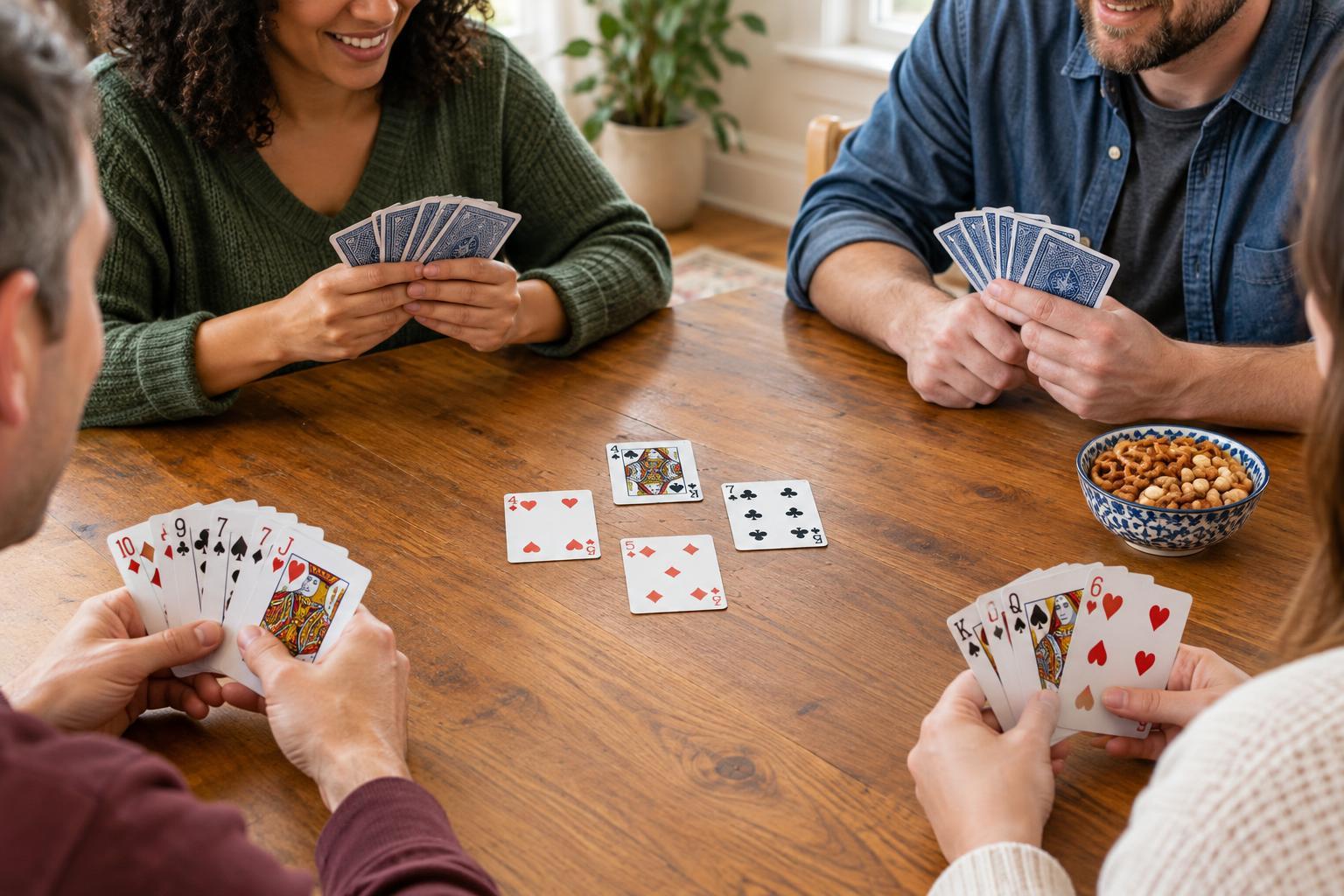
The familiar version uses four players and a standard 52-card deck, with no jokers. Deal all the cards so each player has 13. Cards rank from two up to ace, and there is no trump suit. Before each hand, players commonly pass three cards to a neighbor or the player opposite them. Many groups rotate the direction: left, right, across, then no pass. If everyone is new, agree on the passing pattern and scoring rules before you begin.
How a trick works
A trick is one round of four played cards. One person leads by playing a card; the others each play one card in turn. If you have a card in the suit that was led, you must play that suit. If you do not, you may play a card from another suit. The highest card in the led suit wins the trick, even if someone played a higher card from a different suit. The winner takes the four cards and leads the next trick.
For example, if clubs are led and the four plays are the seven of clubs, ace of clubs, king of hearts, and ten of clubs, the ace of clubs wins. The king of hearts cannot win a club trick, but it still goes into the winner’s pile. This is why being unable to follow suit can be useful: it gives you a chance to discard a card you would rather not keep.
Which cards count as points?
Each heart is worth one point, and the queen of spades is worth 13. Together, those cards add up to 26 points in a hand. All other cards score zero. When a hand ends, count the point cards in the tricks each player took, then add those points to their running totals. You do not score a heart simply for playing it; you score it if you win the trick containing it.
The queen of spades deserves particular attention. If spades are led and you play the queen, a king or ace of spades played after it could take the trick. But if you win a trick containing the queen, you take its 13 points, whether you played it yourself or someone else discarded it. As you play, notice which high spades are still out and whether another player might be waiting for a chance to discard the queen.
Opening rules and playing hearts
In a common set of rules, the player holding the two of clubs leads it to start the hand. Players must follow clubs if they can. Point cards cannot normally be played on this first trick unless a player has no legal alternative. This gives everyone an opening trick before hearts and the queen of spades can enter play freely.
Hearts also cannot normally be led until they have been “broken”: someone must first play a heart because they cannot follow the suit led. Once that happens, hearts may be led like any other suit. A player holding only hearts may usually lead one even if hearts have not been broken. House rules and digital versions can differ on these exceptions, so a quick check before dealing prevents confusion.
A sensible approach to your first game
Start by watching the suit that was led. Following suit is required, so your choice may be narrower than it first appears. When you have several cards in that suit, consider whether your play might win the trick and whether anyone after you could add points to it. Early on, getting rid of a very high card on a trick that looks safe can help, but there is no guaranteed safe play when other players still have cards to reveal.
Passing cards can help you shape your hand. You might pass a high spade that could later win the queen, or pass cards from a suit until you hold none of it. Having no cards in a suit gives you opportunities to discard unwanted cards when that suit is led. Neither choice is always best; use your first few hands to see how the possibilities change as cards are played.
Most groups keep playing hands until someone reaches an agreed score, often 100, and the lowest total wins. One unusual possibility is “shooting the moon”: a player takes all 13 hearts and the queen of spades in one hand. Under a common rule, that player scores zero for the hand and each opponent adds 26, though some groups instead subtract 26 from the player’s total. Agree on that rule in advance. For your first game, the simpler goal is enough: follow suit, track the point cards, and think twice before winning a trick.