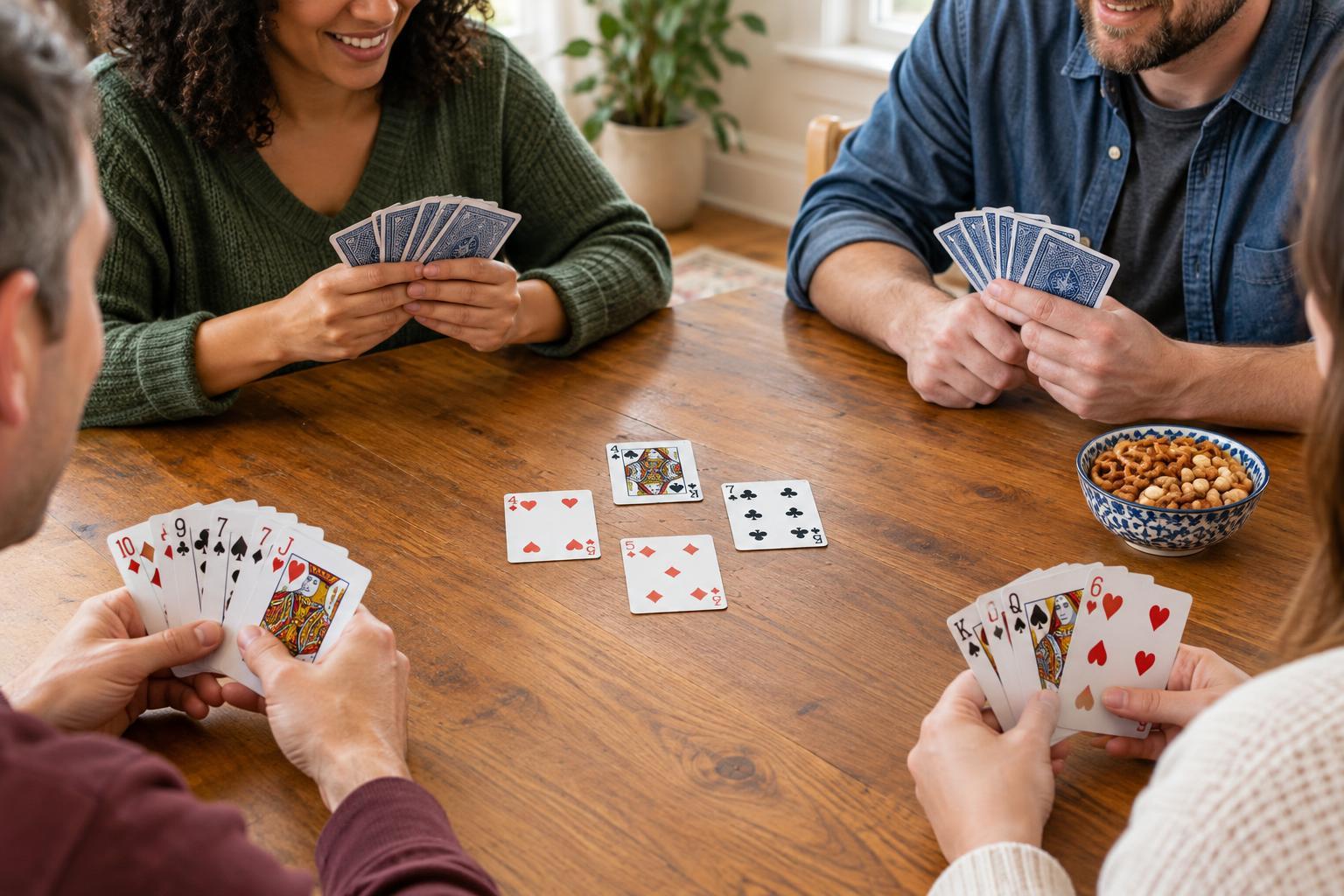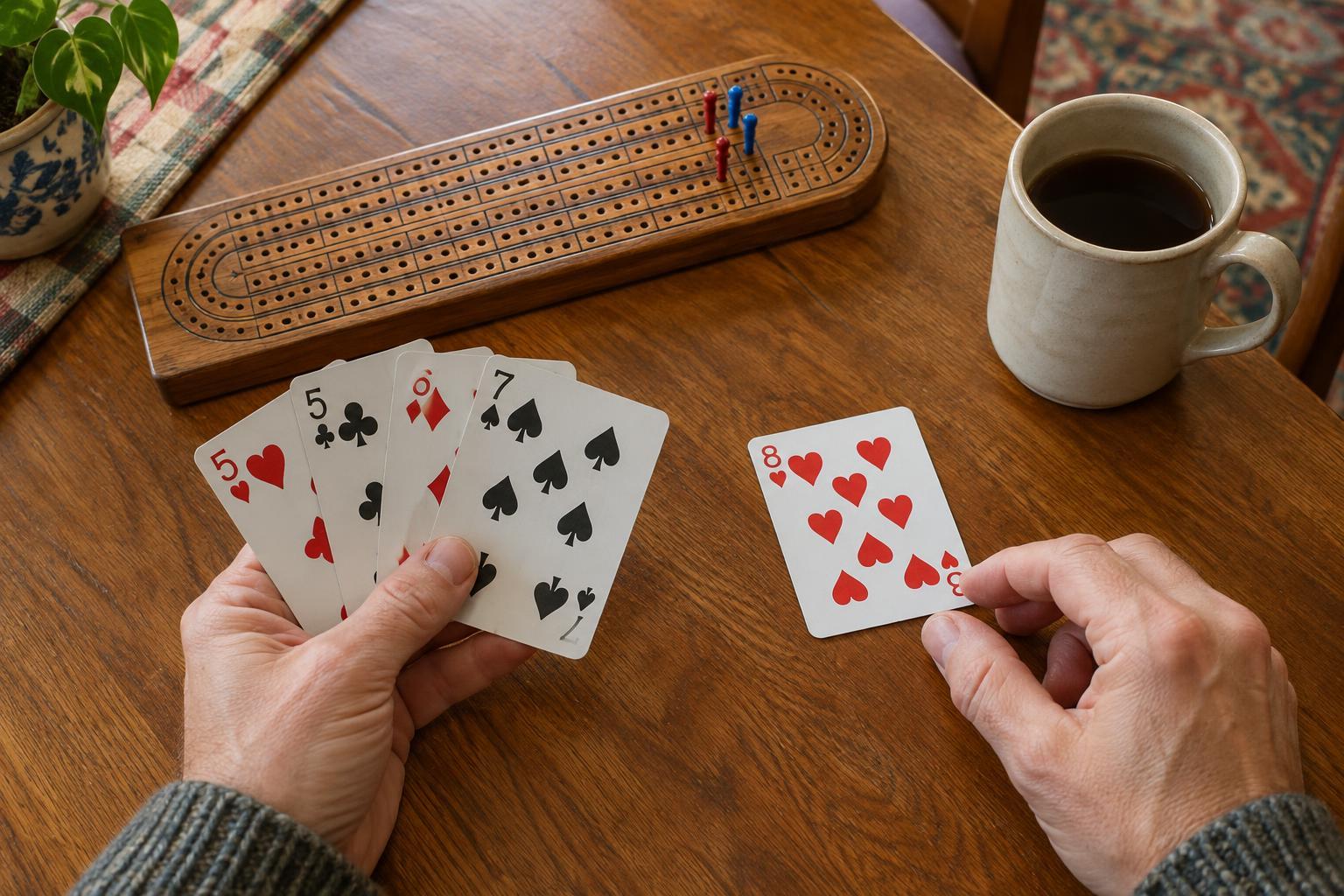
Start with the five cards that count
In standard six-card cribbage, each player keeps four cards after discarding two to the crib. Once the starter card is turned over, score your four kept cards together with that starter. Those five cards can earn points for combinations totaling fifteen, pairs, runs, a flush and nobs. You can use a card in more than one scoring combination; scoring it once does not use it up.
The nondealer counts their hand first, then the dealer counts their hand and the crib. The crib is scored using its four discarded cards plus the same starter card, though its flush rule is stricter. This guide covers hand and crib scoring, not points earned while playing cards during the pegging phase.
Give each card its usual number value when looking for fifteens. Jacks, queens and kings are worth ten; aces are worth one. Keep the ranks visible, too: a jack still matters as a jack when you check for pairs, runs or nobs.
Find every fifteen and every pair
First, look for every distinct group of cards whose values add to exactly fifteen. Each group scores two points. A fifteen might use two cards, three cards or more, so do not stop after checking the obvious pairs. If you have two different fives and a ten-value card, each five makes a separate fifteen with that card. You may also find a fifteen made entirely from lower-value cards.
Next, score matching ranks. Each pair is worth two points. Three cards of one rank contain three different pairs, for six points; four of a kind contain six pairs, for twelve points. Think of the physical cards as distinct, even when their ranks match. That habit helps you catch both the extra pairs and the extra fifteens created by duplicate cards.
A useful check is to point to the cards in each combination as you count it. You can tally fifteens on one line and pairs on another, rather than trying to hold a running total in your head.
Count runs without overlooking duplicates
A run is a sequence of at least three consecutive ranks, worth one point per card in the sequence. Suits do not matter, and the cards need not be arranged in order in your hand. An ace is low, so ace-two-three is a run, but queen-king-ace is not.
Score the longest runs available rather than adding shorter pieces of the same sequence. For example, three-four-five-six scores four for a run of four; you do not also score three-four-five and four-five-six as separate runs. Duplicate ranks can, however, make multiple distinct runs. With four-five-five-six, either five can complete four-five-six. That gives you two runs of three, worth six points altogether, as well as a pair of fives worth two.
Check the flush and nobs last
In a hand, four kept cards of the same suit score four points for a flush. If the starter matches that suit, the flush scores five instead. Three kept cards of one suit plus a matching starter do not make a flush. In the crib, a flush scores only when all four crib cards and the starter share a suit; there is no four-point crib flush.
Nobs scores one point when a jack among your four kept cards matches the starter card’s suit. The same rule applies to a jack in the crib when the dealer counts it. Nobs is separate from other combinations, so that jack may also take part in a fifteen, pair or run. Do not confuse nobs with “his heels”: if the starter itself is a jack, the dealer scores two points when it is turned over, rather than adding those points while counting a hand.
Put the counting order to work
Suppose your four kept cards are a four, two fives and a six, and the starter is a ten. Each five makes fifteen with the ten, for four points. The four and six also make fifteen with each of the two fives, for another four. Your fifteens total eight points.
The two fives form a pair worth two. They also make two separate four-five-six runs, worth six. There is no flush or nobs to add, so the hand totals sixteen points: eight for fifteens, two for the pair and six for runs.
For any hand, follow the same final sweep: list every fifteen, count matching pairs, find the longest runs and their duplicates, then check the flush and nobs. Add the categories only after you have checked each one. A repeatable order is easier to trust than a quick glance, especially when the starter creates combinations you did not have in mind before it was turned over.