Gather the supplies and draw a scorecard
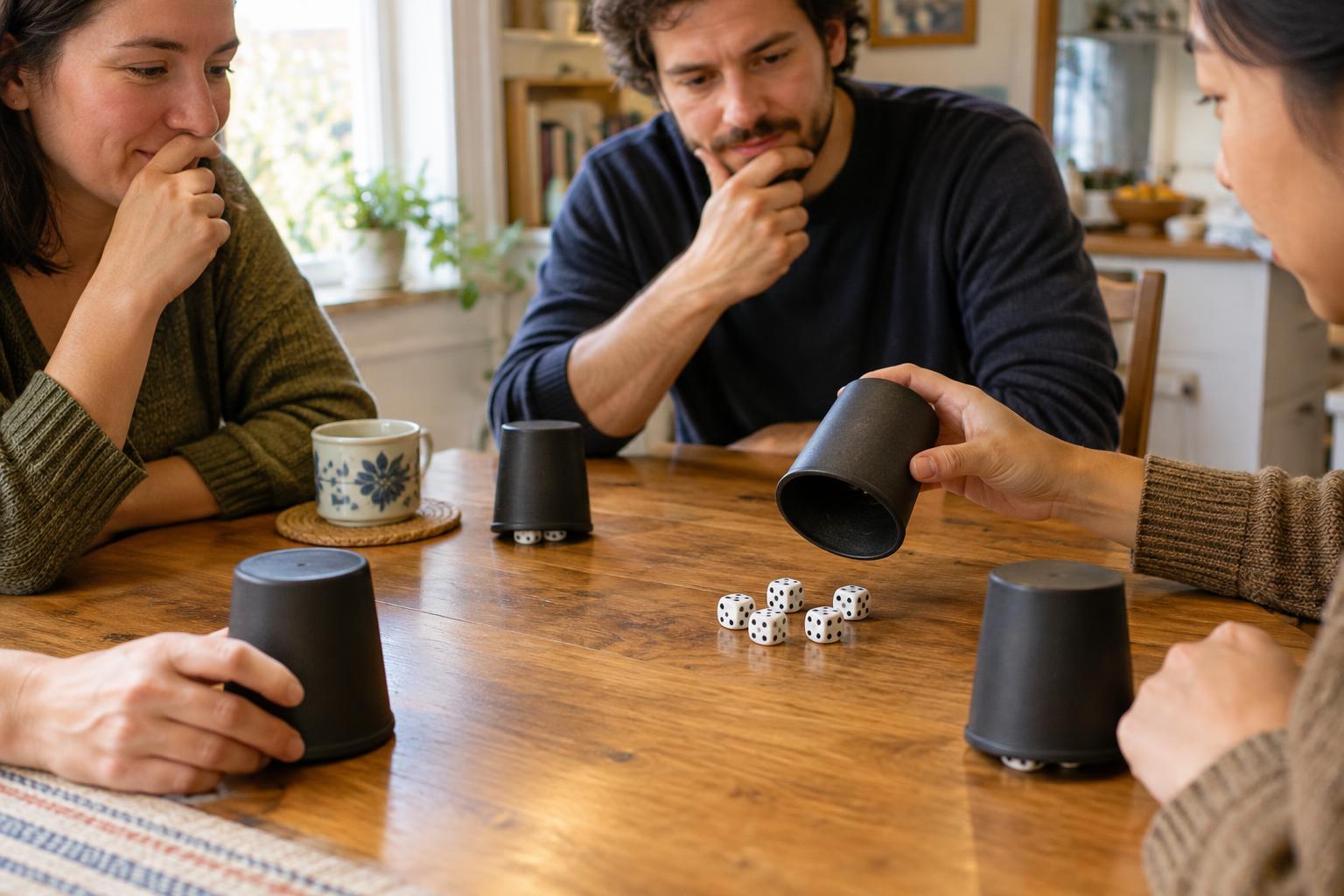
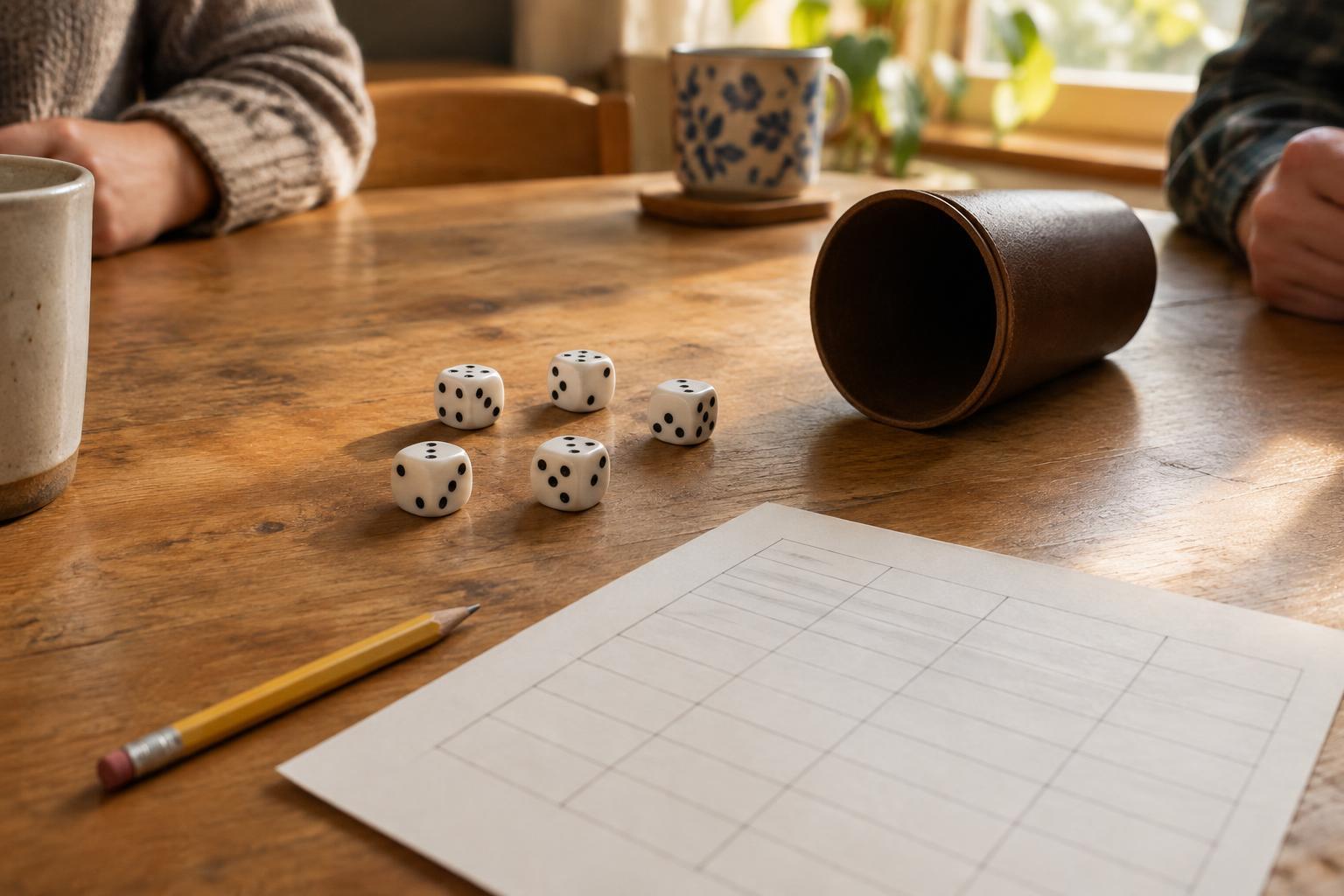
You need five ordinary six-sided dice, a cup for shaking them, a pen and a sheet of paper. Give each player a column on the paper. Down the left side, write these 13 scoring categories: Ones, Twos, Threes, Fours, Fives, Sixes, Three of a Kind, Four of a Kind, Full House, Small Straight, Large Straight, Five of a Kind and Choice. Leave a row at the bottom for each player’s total. Everyone uses the same dice and cup, taking turns.
This is a self-contained version of a familiar scorecard-style dice game. Decide on its rules before the first roll, since different groups may know slightly different versions. In this version there are no bonus points, and each category can be filled only once. After 13 turns per player, every box will contain a number, including any zeroes. The highest total wins.
Take a turn: roll, keep and decide
On your turn, shake all five dice in the cup and roll them onto the table. You may stop and score that result, or keep any dice you like and reroll the others. You can then stop or reroll once more. That means three rolls at most on a turn, counting the first roll. Before each reroll, you may choose afresh which dice to keep; you can even reroll a die you kept earlier.
After your final roll, choose one empty category in your column and write down its score. You cannot save the dice for a later turn, and you cannot change a score once you have written it. If your result does not qualify for a category you choose, write zero there. Taking a zero can be useful when the dice do not fit an available box, but it also means giving up the chance to score in that box later.
For example, suppose you roll 2, 2, 4, 5 and 6. You might keep the pair of twos and reroll three dice to try for matching numbers. Alternatively, you might keep 4, 5 and 6 to pursue a straight. Neither choice promises a good result; the fun comes from deciding what is worth chasing while you still have empty boxes.
Score each category
For Ones through Sixes, add only the dice showing the named number. A roll of 2, 2, 2, 5, 5 scores 6 in Twos or 10 in Fives. Three of a Kind requires at least three dice showing one number; Four of a Kind requires at least four. If you qualify for either category, score the sum of all five dice, not just the matching ones. The roll of 2, 2, 2, 5, 5 therefore scores 16 in Three of a Kind.
A Full House is exactly three of one number and two of another, and scores 25 points. A Small Straight is four consecutive numbers among your dice, such as 2, 3, 4 and 5, and scores 30. A Large Straight is five consecutive numbers—either 1 through 5 or 2 through 6—and scores 40. Five of a Kind requires all five dice to match and scores 50. Choice has no pattern requirement: add all five dice and record the sum. If you select a pattern category without its required pattern, that category scores zero.
You can use a roll in any one eligible empty box, not every box it fits. For instance, 2, 2, 2, 5, 5 qualifies as a Full House and Three of a Kind, but you must choose where to record it. It could also go in Twos, Fives or Choice. Once you have used a box, it stays closed for the rest of the game.
Keep the game moving
Early on, many boxes are open, so you have room to follow whatever the dice offer. Later, look at your remaining categories before choosing which dice to keep. If your Large Straight box is already filled, a promising run may still be useful for Small Straight or Choice. If only difficult patterns remain, consider whether to use a turn to score zero in one of them rather than sacrificing a box that could earn dependable points.
For a smooth first game, put the scorecard where everyone can see it and read out the chosen category before writing a score. Players can help check arithmetic without making decisions for the person rolling. When all players have taken 13 turns, add each column carefully. If totals tie, you can simply share the win—or agree before starting that tied players will play one extra turn, each rolling up to three times and comparing the sum of their final five dice.