Gather supplies and pick a starting idea
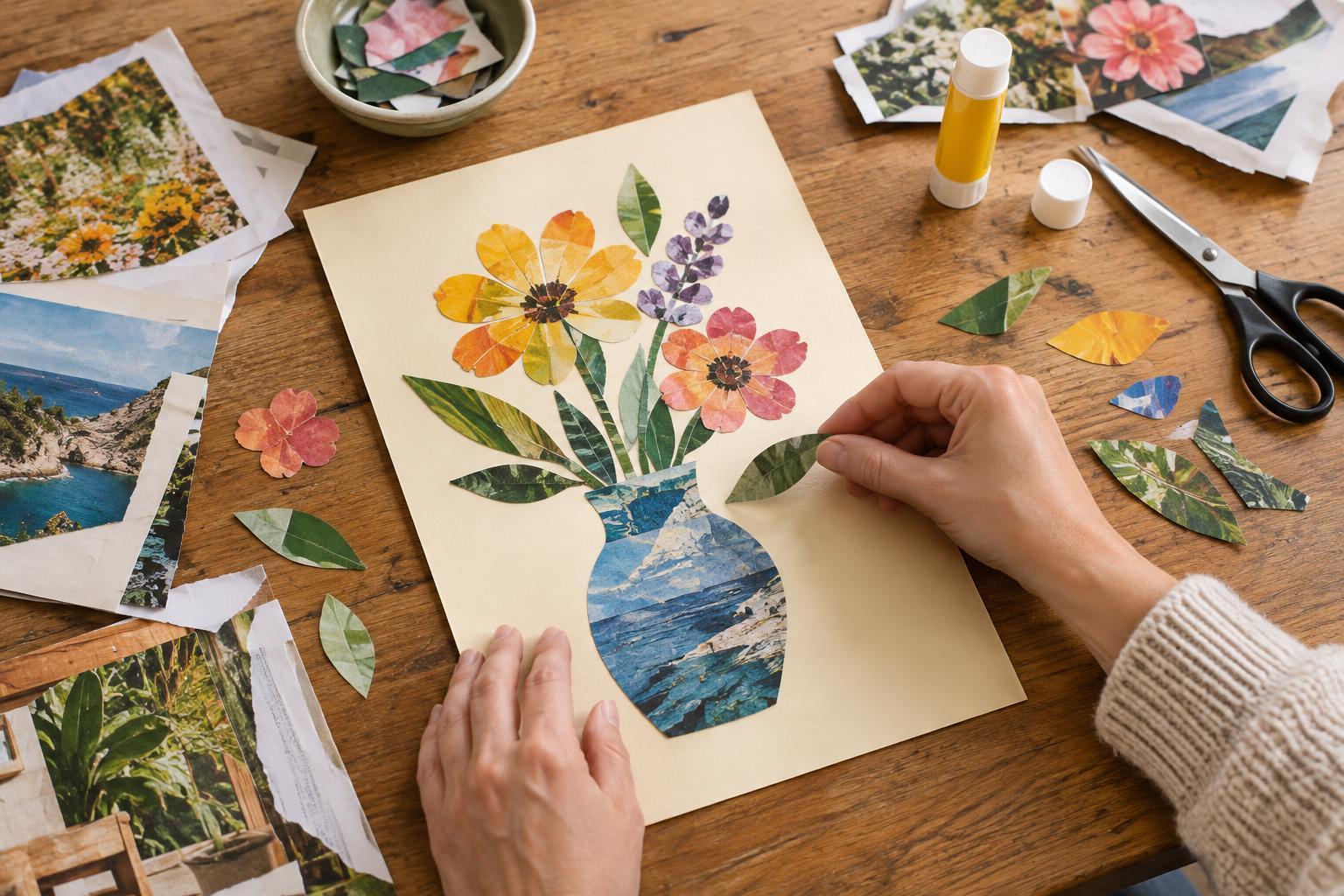
A cut-paper collage is a picture built from separate pieces of paper. Magazine pages work especially well because they offer photographs, patterns, colors, and lettering in one inexpensive supply. You do not need to draw well or own special equipment. Gather a few magazines, scissors, a glue stick, a pencil, and a sturdy sheet of paper or thin card for the background. Keep a scrap envelope or small bowl nearby for pieces you might use later.
Give yourself a loose idea before cutting. You could make a scene, such as a garden made from unexpected objects, or choose a feeling, such as a lively morning. If that sounds too open-ended, pick one color and build around it. Your idea is a starting point, not a rule: an interesting scrap may suggest a better direction once you begin.
Look for useful shapes, not just whole pictures
Flip through the magazines and pull pages that catch your eye. Look beyond obvious subjects. A sleeve might become a mountain, a photo of water could serve as a sky, and a printed headline might add rhythm to the composition. Collect a mix of large areas, medium shapes, and small details. If you only choose tiny pieces, the collage may take longer to assemble than you expect.
Cut a few bold shapes first, then trim them more closely if needed. Scissors are enough for most projects; simple edges can be as effective as intricate ones. Save interesting offcuts, including strips of color and partial letters. If you are making a collage with someone else, share a pile of pages and compare what each person notices. The same image can become entirely different material in different hands.
Arrange the pieces before you glue
Place your biggest piece on the background without attaching it. Add other pieces around or partly over it, moving them until your eye has somewhere to begin and somewhere to travel next. Try leaving some background visible rather than filling every gap. Empty space can make a busy group of magazine images easier to read.
Check the collage from a little distance. Does one shape stand out as the main feature? Are several pieces competing for attention? You can simplify by removing an image, or create a stronger connection by repeating a color in another part of the page. Rotate pieces and test unusual pairings before deciding they do not belong. A quick photo of an arrangement can help you remember it if you want to try a second version.
Glue in layers and handle glossy paper gently
Once you like the arrangement, set the pieces beside the background in roughly the same order. Glue larger background pieces first and add smaller details on top. Apply the glue stick across the back of each piece, paying particular attention to the edges, then press it down from the center outward. A clean scrap sheet under your work can catch extra glue; replace it when it gets sticky.
Magazine paper can be thin or glossy, so use a light hand. Too much wet glue may wrinkle it, while too little glue may leave corners lifting. If a piece curls, gently smooth it with clean fingers or place a spare sheet of paper over it and press. Let the finished collage dry flat before moving it. For a crisp edge, you can trim any paper that extends beyond the backing once everything has set.
Finish, display, and try another variation
Decide whether the collage needs anything else before adding more. A small cut-out word or a repeated shape may bring the page together, but it is fine to stop while the arrangement still feels spacious. You can display the result on a shelf, attach it to a card, or tuck it into a notebook. Keep it away from damp spots, since ordinary paper and glue may not hold up well there.
For your next collage, change just one part of the process. Limit yourself to two colors, make a picture using only text and patterns, or build a scene entirely from pieces that were not originally landscapes. These small constraints make a fresh project easier to start. Keep your leftover scraps in an envelope: the odd fragment you could not use today might become the centerpiece of another page.