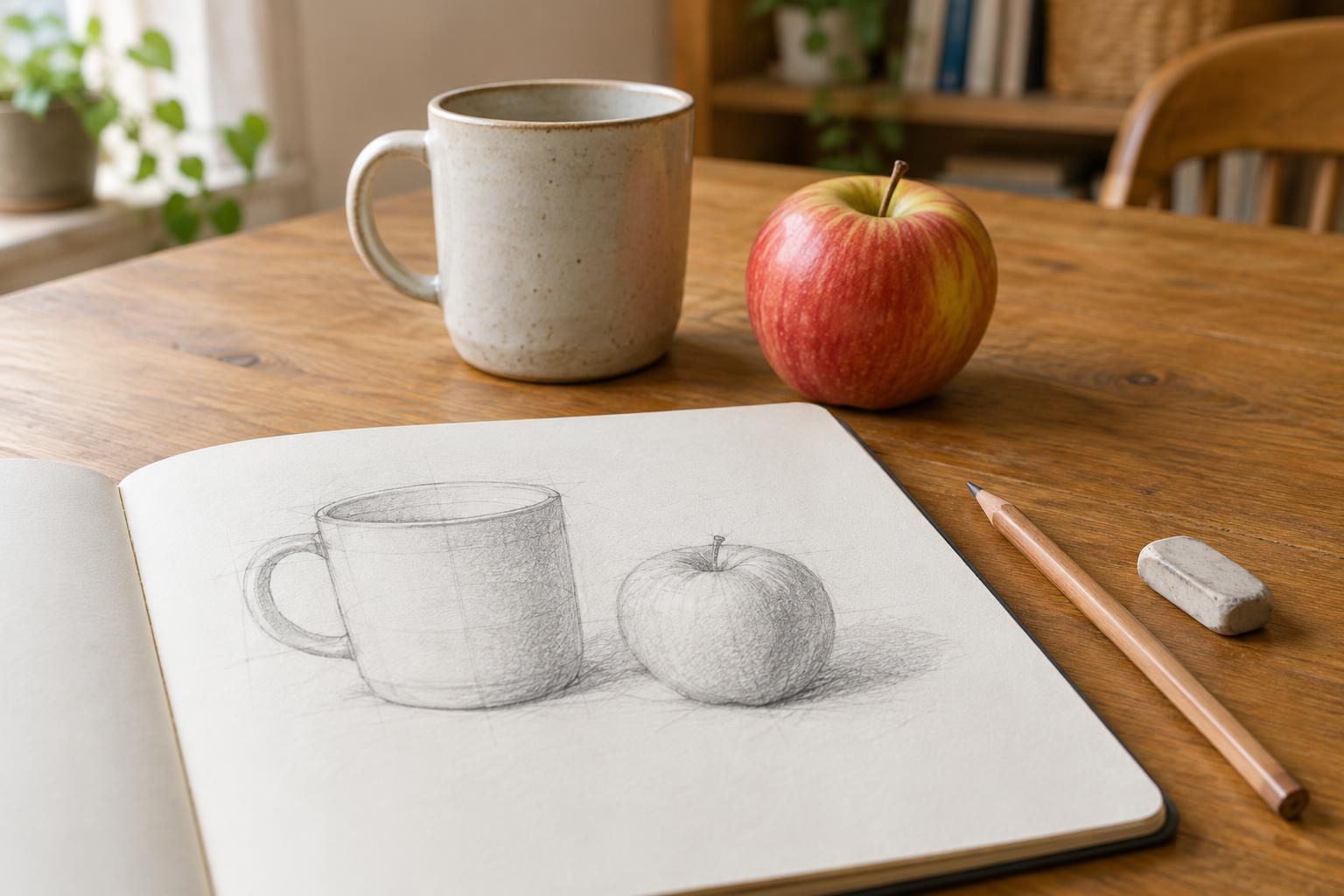
Start with one object and a simple setup
Observational drawing means drawing what you can see in front of you rather than what you remember an object looking like. A mug, shoe, houseplant pot or piece of fruit is enough to get started. Familiar objects are useful because they are easy to find, but they can also surprise you: the handle of a mug may be narrower than you expect, and an apple may be less symmetrical than the version in your head.
All you need is paper, a pencil and an eraser. Choose an object that will stay still, set it on a clear surface and sit where you can see it comfortably. A lamp or window can make its light and dark areas easier to notice. Try to keep your seat, object and light in the same places until you finish; changing your viewpoint midway can make the shapes appear to shift.
Look for the big shapes first
Before making marks, spend a moment looking at the object’s overall height and width. Ask yourself whether it would fit more naturally inside a tall rectangle, a wide rectangle or a square. On the page, draw that outer area lightly. Leave space around it so you do not have to squeeze in a handle, leaf or shadow later.
Next, simplify what you see. A mug might begin as a rounded rectangle with an oval at the top; a pear might begin as two uneven rounded forms. These are starting guides, not a formula the object must follow. Use loose, pale lines that you can adjust. Small details such as patterns, scratches and lettering can wait until the larger shape feels believable.
Compare relationships instead of guessing
The most helpful drawing question is often not “What shape is this?” but “How does this part compare with that one?” Look at where the widest point falls, how much of the object sits above its midpoint and where smaller parts attach. If you are sketching a mug, compare the handle’s height with the cup’s height and the opening’s width with the base. Checking one relationship at a time is less overwhelming than trying to draw the whole object perfectly.
You can also use your pencil as a simple measuring aid. Hold it out at arm’s length, close one eye and use your thumb to mark an apparent width or height on the pencil. Compare that span with another part of the same object, keeping your arm extended in the same way. This does not give you an exact measurement on paper; it helps you notice proportions. Pause occasionally to look back at the object rather than judging the sketch only by itself.
Add edges and shadows gradually
Once the main proportions are in place, pay attention to the edges. Some may look crisp, while others blend gently into a shadow or background. An oval opening, for example, may need a darker line at its near edge and a lighter line at the far side. Varying your pressure can suggest these differences without outlining every part equally.
For shading, first identify the lightest and darkest areas you can see. Leave the lightest area mostly untouched and build darker tones with gentle pencil strokes. Look for the shadow the object casts on the surface beneath it; that shadow can help it feel grounded. You do not need to copy every change in tone. A few clear differences between light, middle and dark areas often describe the form better than hurried, heavy shading.
Make practice small enough to repeat
Try a short sketch of one object, then draw the same object again from a different seat or after turning it slightly. On the second attempt, choose one thing to watch more closely, such as the angle of an edge or the space inside a handle. Repeating a subject makes changes easier to notice and removes the pressure to find something new to draw every time.
Keep your early sketches, including the awkward ones. They can remind you which observations were difficult and show how your attention changes with practice. If a drawing feels stuck, step back and compare its largest shapes with the object before correcting tiny details. The aim is not a flawless picture of a mug or a shoe. It is to spend a few minutes looking carefully and making a record of what you noticed.