What the numbers mean
The first number on a binocular label tells you its magnification. An 8× pair makes a distant bird appear about eight times closer; a 10× pair makes it appear about ten times closer. The second number, as in 8×42 or 10×42, is the diameter of the front lenses in millimeters. When comparing two pairs, check both numbers rather than assuming magnification tells the whole story.
For casual birdwatching, the useful question is not simply which pair brings a bird closer. It is which pair helps you find the bird, keep it in view, and see enough detail to enjoy it. Trees, moving birds, changing light, and a quick glance between conversations all make ease of use important.
Why 8× is often easier to use
An 8× view is generally easier to hold steady by hand. Binoculars magnify the small movements of your hands as well as the bird, so a higher-power image can seem to wobble more. That difference may be especially noticeable after you have been holding a pair up for a while or when you are trying to follow a bird hopping through branches.
Eight-power models also commonly offer a wider field of view than otherwise similar 10× models. That gives you a larger patch of the scene to search. If a friend points out a bird near the top of a tree, a wider view can make it simpler to locate the right branch before the bird moves. It can also make following a flying bird feel less like trying to look through a narrow tube.
If you mostly watch birds on neighborhood walks, in parks, or from a window, 8× is a friendly starting point. It gives you a useful close-up without demanding especially steady hands or a practiced technique.
When 10× may be worth choosing
Ten-power binoculars can help when birds tend to be farther away, such as across an open field or on the far side of a pond. The extra magnification may make markings easier to inspect without moving closer. It does not, however, guarantee a clearer view: focus, lens quality, lighting, and how steadily you can hold the binoculars still matter.
The trade-off is a view that can feel shakier and, often, narrower. If you usually pause in one place to scan distant perches, you may be comfortable with that exchange. Resting your elbows on a railing or against your body can help steady either magnification. If your outings involve walking under trees and reacting quickly to nearby birds, the extra power may be less helpful than you expect.
Compare complete pairs, not just magnification
Two binoculars marked 8×42 can still feel quite different. Size, weight, grip, focus wheel, and the distance between the eyepieces all affect comfort. If you wear glasses, check whether you can see the full circular view with the eyecups turned down; the eye-relief specification can help, but trying the pair is more convincing. A close-focus capability is handy if you also enjoy watching birds or insects nearby.
Front-lens size involves another trade-off. Larger lenses can help provide a brighter view in dim conditions, but they often make binoculars bulkier. A compact pair that you happily carry on an ordinary walk may serve you better than a larger pair left at home. Water-resistant construction can also be useful for outings in unpredictable weather, though you should check what protection a particular model actually offers.
If possible, test binoculars outdoors or look toward a distant, detailed object in a shop. Notice how quickly you can find it, bring it into focus, and keep it centered. Try both hands and hold the pair up for more than a few seconds. Comfort is part of performance.
A simple way to decide
Choose 8× if you want a versatile pair for walks, gardens, wooded parks, and birds that move frequently. Choose 10× if you often watch across open spaces and find that you can comfortably hold the view steady. Neither choice is a rule: a comfortable, clear 10× pair may suit you better than an awkward 8× pair, or vice versa.
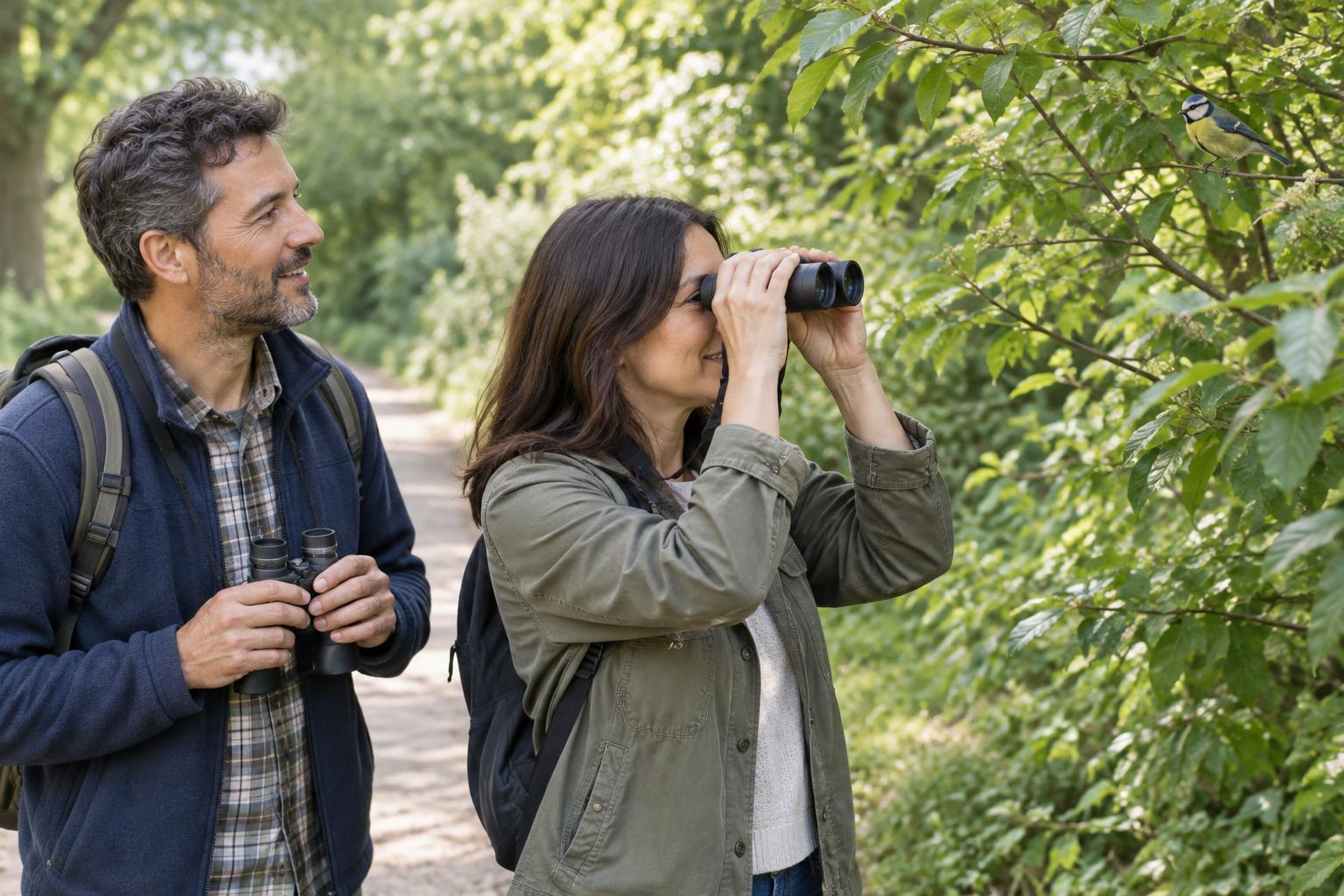
You do not need to identify every bird to get value from binoculars. Take them on a familiar route, stop when you hear movement, and first locate the bird with your eyes. Then lift the binoculars toward the same spot rather than searching at random through the lenses. The easier your pair makes that small routine, the more likely it is to become a hobby you enjoy.