Set up the board and learn the basic move
Checkers is easy to set up and quick to start, which makes it a good game to keep on hand for a quiet evening or a casual visit with friends. This guide uses the common eight-by-eight version often called American checkers or English draughts. Other versions have different rules, so agree on which one you are playing before the first move.
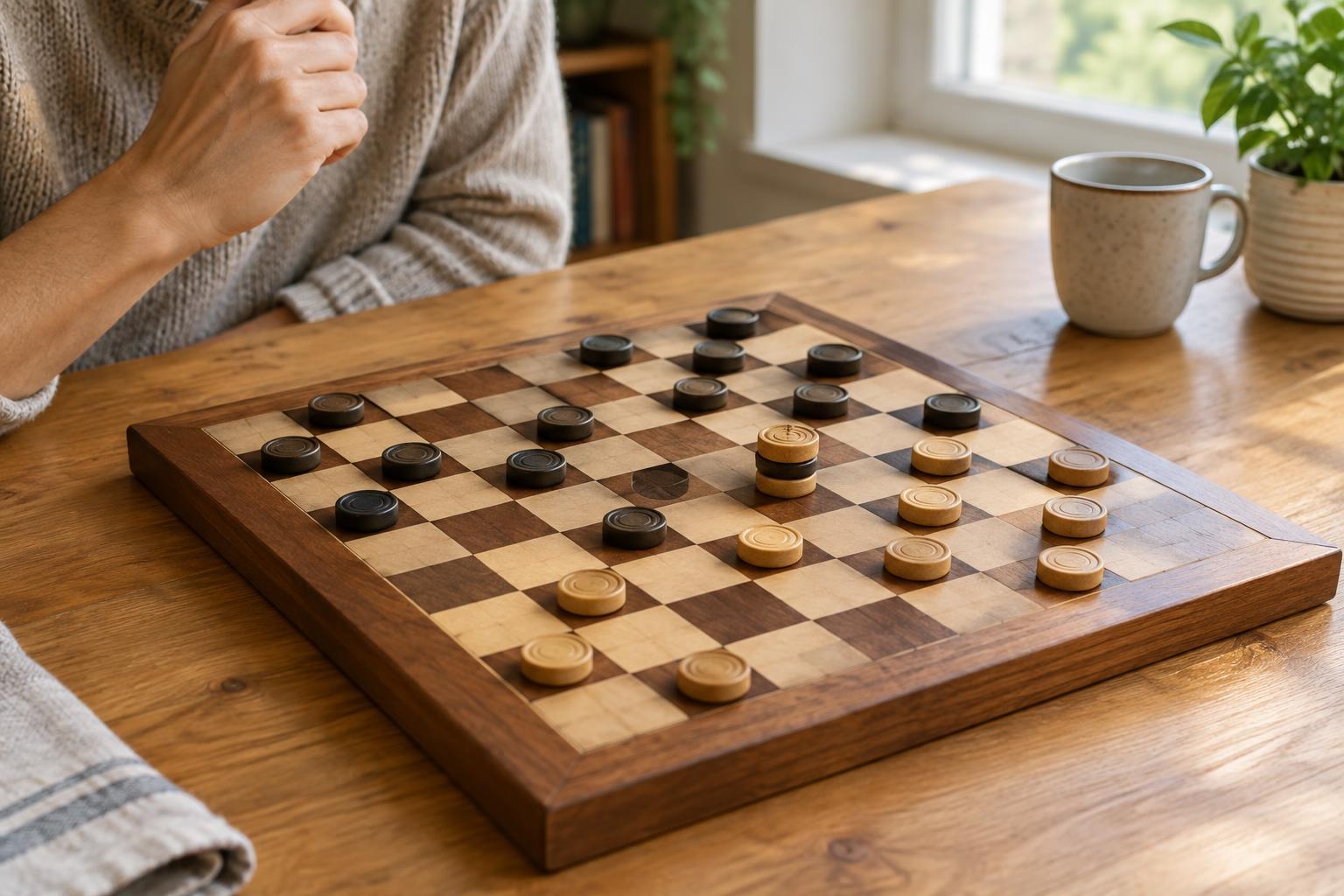
Place the board so each player has a dark square at the left end of the row nearest them. Each player puts 12 pieces on the dark squares of their three nearest rows. Pieces stay on dark squares throughout the game. Players take turns moving one piece at a time; an ordinary piece, often called a man, moves one square diagonally forward into an empty square. Decide who moves first, then keep taking turns until one player has no legal move left.
The aim is to leave your opponent unable to move, usually by capturing all their pieces or blocking the pieces that remain. At first, concentrate on spotting legal moves rather than trying to plan the whole game. The direction of travel and the dark-square pattern will soon feel natural.
Forced captures and multiple jumps
A capture happens when an opposing piece sits diagonally next to yours and the square immediately beyond it is empty. You jump over the opposing piece into that empty square and remove the jumped piece from the board. In this version of checkers, an ordinary piece captures forward; it cannot jump backward until it becomes a king.
If you can capture on your turn, you must capture instead of making an ordinary move. Check every one of your pieces before choosing a move: the required jump might belong to a different piece than the one you were watching. When more than one capture is available, you may choose which available jump to take under these rules.
After a jump, look again from your piece’s new square. If that same piece can make another legal jump, it must continue jumping during the same turn. A series of jumps can change direction, provided every jump is legal for that piece. You cannot stop a capturing turn early simply because the new position looks safer. This is why an apparently tempting capture may be a trap: it can pull your piece into a square your opponent can attack next.
What changes when a piece becomes a king
When an ordinary piece reaches the farthest row from its starting side, it becomes a king. Players commonly mark this by stacking a second checker on top. A king can move one square diagonally forward or backward into an empty square. It can also capture in either direction by jumping an adjacent opposing piece and landing on the empty square just beyond it.
A king does not move any distance it likes in this version of checkers. Before moving one across the board, picture each single diagonal step and check whether the next square is open. Forced-capture and continuing-jump rules apply to kings too, so gaining the ability to move backward does not mean gaining the choice to ignore a jump.
One detail is worth settling before play if you have learned from another ruleset: in American checkers, a piece that reaches the farthest row during a capture is crowned and its turn ends. It does not immediately continue jumping backward as a new king. Agreeing on this point early prevents an argument at an exciting moment.
Beginner mistakes that are easy to fix
The most common oversight is making a quiet move while a jump is available. Before each turn, scan for opposing pieces beside any of your pieces, then check the landing squares beyond them. After every capture, repeat the scan from the landing square so you do not miss a required second jump.
Another mistake is focusing only on the piece you hope to move. Your opponent may be offering a capture that forces a different piece out of position. Look at the whole board before accepting an attractive jump, and consider where your piece will land at the end of every required jump in the sequence.
New players also tend to give away pieces by moving one checker forward without checking the square behind it. Before you move, ask: if my piece lands here, can an opposing piece jump it on the next turn? Keeping nearby pieces in positions where they protect one another can make your side harder to attack. Avoid crowding every piece together, though; a blocked piece has fewer useful moves.
Finally, do not assume a king is safe just because it can retreat. Kings are valuable, but they can still be captured if they step beside an opponent with an empty landing square behind them. Treat a new king as a flexible piece, not an invincible one.
A simple way to practice
For your first few games, pause at the start of every turn and use the same three questions: Is a capture available? If I jump, must I jump again? What can my opponent capture afterward? This short routine reinforces the rules while helping you notice threats before committing to a move.
If you are teaching a friend, play a slow practice round in which both players point out available jumps. You can return to competitive play once forced captures and kings feel familiar. Checkers becomes more engaging when both players understand why a move is required—and can start planning around what it might force the other person to do.