Set up the board and pieces
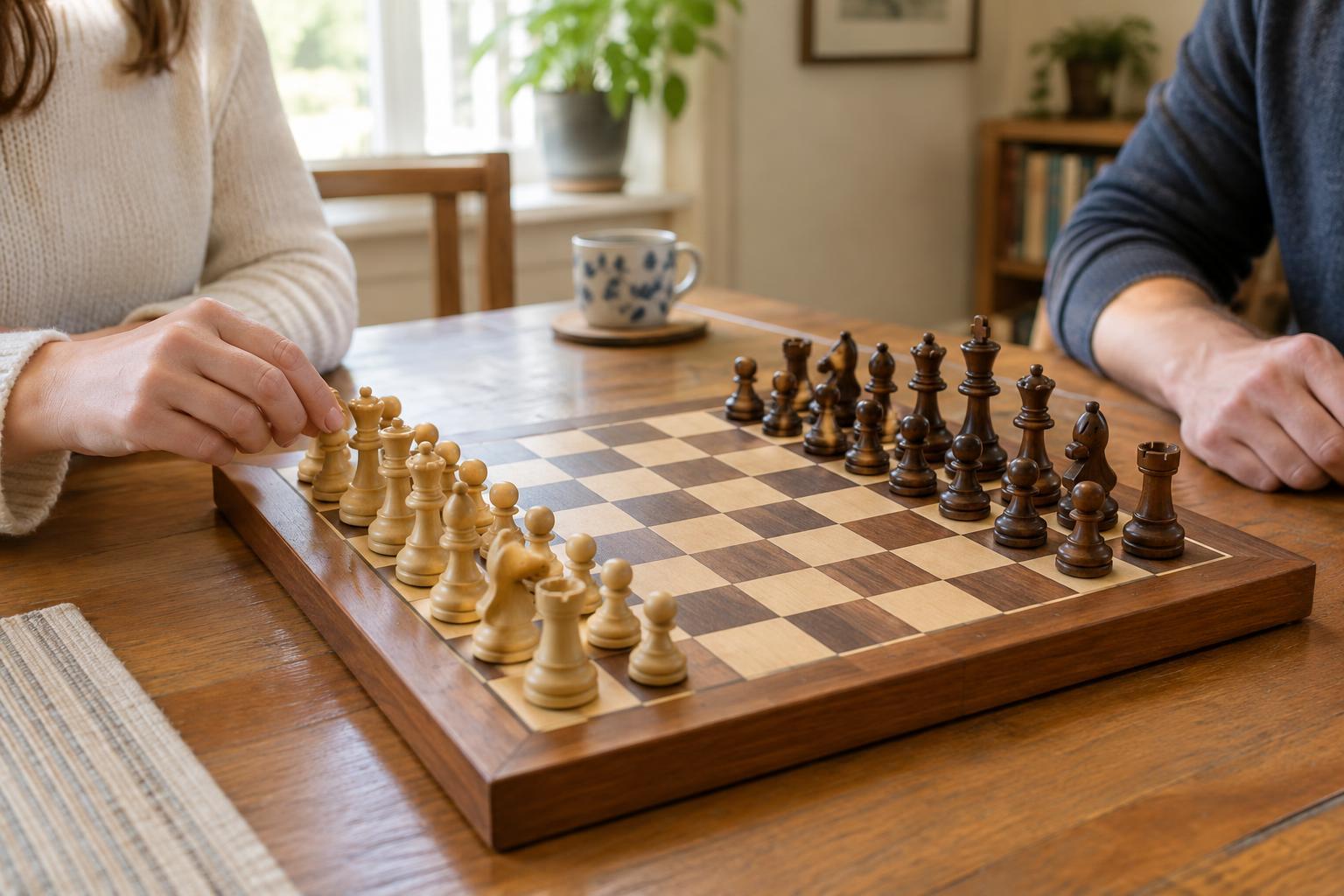
Chess is a two-player game played on a board of 64 alternating light and dark squares. Sit opposite your opponent and turn the board so that each player has a light square at the right-hand corner nearest them. A handy reminder is “light on the right.” White moves first, and the players then take turns making one move at a time.
Place your eight pawns in a row directly in front of your other pieces. On the back row, put a rook in each corner, then a knight next to each rook, then a bishop next to each knight. Two spaces remain in the center: the queen starts on a square matching her color, and the king takes the last square. Check both sides before starting; the pieces should face their counterparts across the board.
Learn how each piece moves
The rook moves any number of squares horizontally or vertically. The bishop moves any number of squares diagonally. The queen combines those movements: she can travel along a row, column, or diagonal. None of these pieces can jump over another piece. They capture an opposing piece by moving onto its square.
The knight moves in an L shape: two squares in one direction and one square at a right angle. It is the only piece that can jump over pieces in its path. The king moves one square in any direction. A king cannot move onto a square where an opposing piece could capture it.
Pawns move forward one square into an empty space, or two squares on their first move if both spaces are empty. Unlike other pieces, they capture one square diagonally forward, not straight ahead. Pawns never move backward. If a pawn reaches the far edge of the board, you replace it with a queen, rook, bishop, or knight of the same color. Most beginners choose a queen.
Understand the goal and the special moves
Your goal is to checkmate the opposing king. A king is in check when an enemy piece could capture it on the next move. If your king is in check, you must respond immediately: move the king to safety, capture the attacking piece, or block the attack if possible. You cannot make a move that leaves your own king in check.
Castling is a special move that helps shelter your king. The king moves two squares toward a rook, and that rook moves to the square the king crossed. You may castle only if neither piece has moved, no pieces stand between them, your king is not currently in check, and the king does not cross or land on a square under attack. It is the only move in which you move two of your pieces at once.
Another special pawn capture is en passant. If an opposing pawn advances two squares from its starting position and lands beside your pawn, your pawn may capture it as though it had advanced just one square. You must make this capture immediately on your next turn or lose the chance. You can leave this rule until you are comfortable with ordinary pawn moves, but it is useful to know it exists.
Play from the first move to the finish
To begin, try moving a central pawn so that your bishops and queen have room to develop. Bring your knights and bishops into play, look for a safe opportunity to castle, and avoid moving the same piece repeatedly without a reason. Before each move, ask three questions: Is my king safe? Is any of my pieces under attack? What might my opponent do next? You do not need a complicated plan to enjoy a first game.
As pieces come into contact, you can capture an opposing piece by moving onto its square and removing it from the board. Captures are usually optional. Take your time with each turn, especially after your opponent gives check. A piece that looks free to capture may be protected by another piece, so look at the destination square before committing.
The game ends in checkmate when a player’s king is in check and has no legal way to escape; the player delivering checkmate wins. It can also end in a draw. One common example is stalemate: a player is not in check but has no legal move. Players may also agree to a draw. The king is never actually captured—once checkmate occurs, the game is over.
Make your first game a learning game
For your first few games, keep the rules nearby and say your reasoning out loud if your opponent is happy to learn together. After a move, briefly scan the rows, columns, and diagonals that have opened up. That habit makes it easier to spot attacks from rooks, bishops, and queens.
When the game ends, reset the pieces and try again. Pick one moment to discuss—perhaps a missed check or a pawn that could have promoted—rather than trying to remember every move. Finishing a game, noticing what changed, and playing another is a practical way to build confidence.