What you need and how to deal
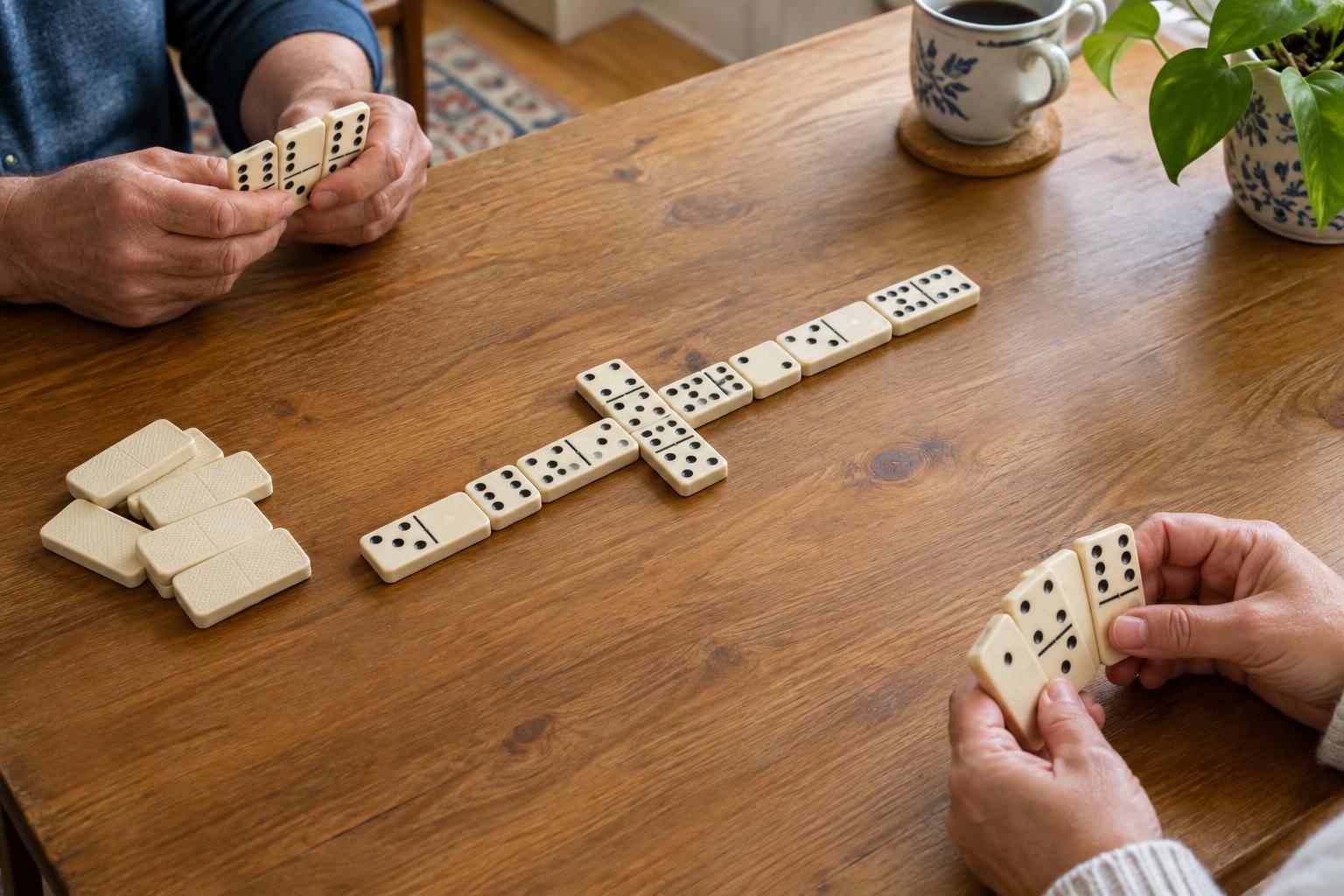
Draw dominoes is a straightforward matching game for two to four people. A standard double-six set has 28 tiles, with ends marked from blank to six. You need the set and enough table space to build a line of tiles. Players keep their own tiles hidden from one another, but everyone can see the line as it grows.
Turn all the tiles face down and mix them. For two players, each person takes seven tiles. For three or four players, each takes five. Leave the remaining tiles face down in a shared pile called the boneyard. Stand your tiles on edge or hold them so you can see their ends without showing your opponents.
Start the line and take turns
For an easy way to choose the first player, have everyone check their hand for doubles: tiles with the same mark on both ends. Whoever has the highest double places it in the middle of the table and starts the line. If nobody has a double, the player with the tile showing the highest total number of pips starts instead. If totals tie, choose the tile with the higher single end. Play then moves clockwise.
On your turn, place one tile against either open end of the line. The touching ends must match: a tile with a four on one end can connect to an open four. A blank matches a blank. You may turn a tile around to make it fit, but you cannot place it in the middle of the line or change tiles already played.
Doubles are often laid crosswise so they are easy to spot. In this simple version of draw dominoes, a double still has just one end available for the next tile; it does not create extra branches. If you play a double-four on an open four, the new open end is another four. Keeping the line gently curved can help it fit on a small table without changing the rules.
Draw when you cannot play
If you have a tile that matches either open end, play one tile and end your turn. If none of your tiles fits, take a tile from the boneyard and check it. If it fits, play it on that turn. If it does not, keep it hidden with your hand and draw again. Continue until you draw a playable tile or the boneyard runs out.
When the boneyard is empty and you still cannot play, pass. The next player takes their turn. Drawing can give you a useful tile immediately, but it also leaves you holding more tiles if you still cannot move. As the line develops, watch both open ends rather than planning around only one of them.
Finish a round and settle close calls
A round ends when someone plays their last tile. That player wins the round. A round can also become blocked: the boneyard is empty, every player still has tiles, and nobody can match either open end. In that case, each player adds up the pips on the tiles left in their hand. The player with the lowest total wins the blocked round. If the lowest totals tie, you can call the round a tie or agree to play another round.
You do not need to keep a running score to enjoy a game. If you want to play several rounds, agree on a scoring method before you begin. One simple option is to give each round’s winner points equal to the pips left in everyone else’s hands, then play to an agreed target. For a first game, it is usually easier to focus on matching, drawing and recognizing when the round is over.