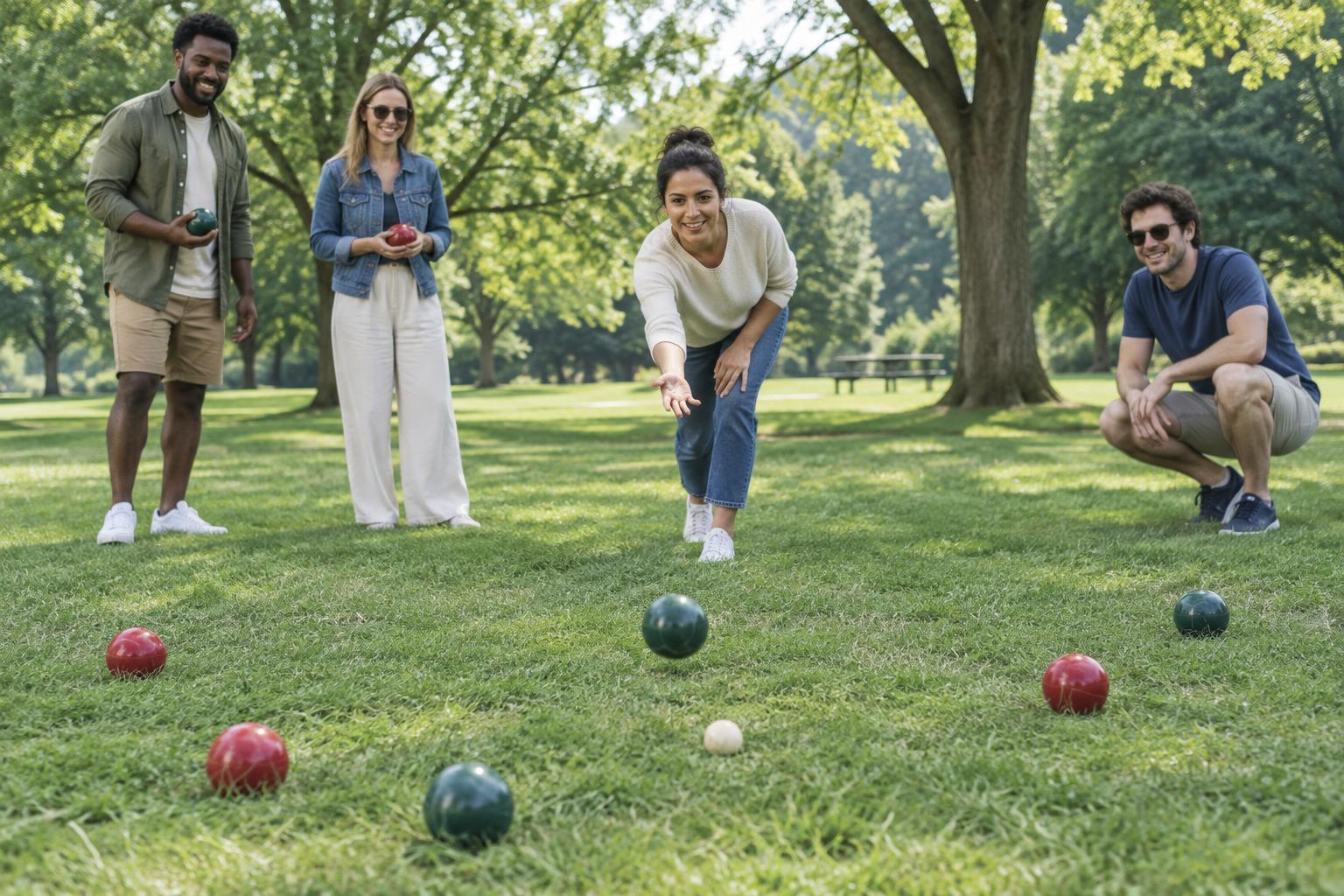
What to bring and where to play
A basic bocce set usually has eight large balls in two colors and one smaller target ball, often called the pallino. Bring the set, a bag for carrying it and, if you like, a tape measure for close calls. You do not need a marked court to enjoy a casual game.
Look for a reasonably flat stretch of grass, packed dirt or gravel with room for players to stand behind one end and roll toward the other. Avoid paths, picnic spots and places where a stray ball could reach other park visitors. Before playing, agree on the side boundaries and a far end line. Shoes, water bottles or other visible objects can mark the corners, but keep them clear of the rolling area.
A space of roughly 40 to 60 feet in length can work for a relaxed game, though a shorter space is fine if everyone prefers gentle throws. Uneven ground adds surprises; it does not have to be perfect. Check any posted park rules, and choose a spot where your group will not get in anyone’s way.
Divide into teams and start a round
Bocce works well with two teams. In a one-on-one game, each person takes four balls. With two players per team, each takes two. With four players per team, each takes one. Give each team one ball color so it is easy to tell the throws apart. If your group has an uneven number of players, divide the eight balls between the teams as evenly as you can and agree on the rotation before starting.
Choose a team to begin. A player from that team stands behind the starting line and tosses or rolls the pallino into the playing area. If it lands outside your agreed boundaries, simply try again. That same team then rolls its first bocce ball, aiming to finish as close to the pallino as possible. Players should release every ball from behind the same line.
Take turns aiming for the pallino
After the first bocce ball lands, the other team throws until one of its balls is closer to the pallino. Then the team that is farther away takes its turn. Continue this way until all eight bocce balls have been played. If one team runs out of balls, the other team throws its remaining balls. For a first game, it helps to pause after each throw and ask, “Which team is closest?”
You may roll a ball gently, send it with a little more force to knock another ball aside, or aim at the pallino itself. Balls and the pallino can move during a round; judge their positions only after everything has stopped. To keep play comfortable in a shared park, use underhand throws and avoid lofting balls high into the air. Call out before retrieving a ball, and wait until everyone has finished throwing.
If a ball leaves your agreed playing area, use a simple house rule: remove it from that round. You can also decide before the game whether a pallino knocked out of bounds means a replay. The important part is to settle these details together rather than debating them mid-round.
Score the round
Once all the balls have been thrown, only the team with the ball closest to the pallino scores. It gets one point for each of its balls that is closer to the pallino than the other team’s closest ball. For example, if a team has the two nearest balls and its opponent has the third-nearest ball, the scoring team gets two points. The other team gets none that round.
For a close call, compare the distance from each ball’s nearest edge to the pallino’s nearest edge. A tape measure can help, but if your group is playing for fun, agreeing on a tie or replaying the round is also reasonable. Record the points, gather the balls and start again from the opposite end. Let the team that scored roll the pallino for the next round. Before you begin, pick a target score, such as 12, so everyone knows when the game will end.
Make the game fit your group
New players often have more fun when the first round is treated as practice. Try a few gentle rolls to see how the surface affects the balls. Grass may slow them quickly, while a firm path-like surface may let them travel farther. If reaching the pallino feels too difficult, shorten the playing area instead of asking everyone to throw harder.
Bocce can be a quiet one-on-one activity or a social game with teammates discussing where to aim. Keep turns moving, make room for players who prefer a shorter throwing distance, and agree on friendly rules before a close score makes them matter. Once your group understands the basic rhythm—roll toward the pallino, let the farther team throw, then count the closest balls—you can set up another game almost anywhere suitable.