Start with a few dots
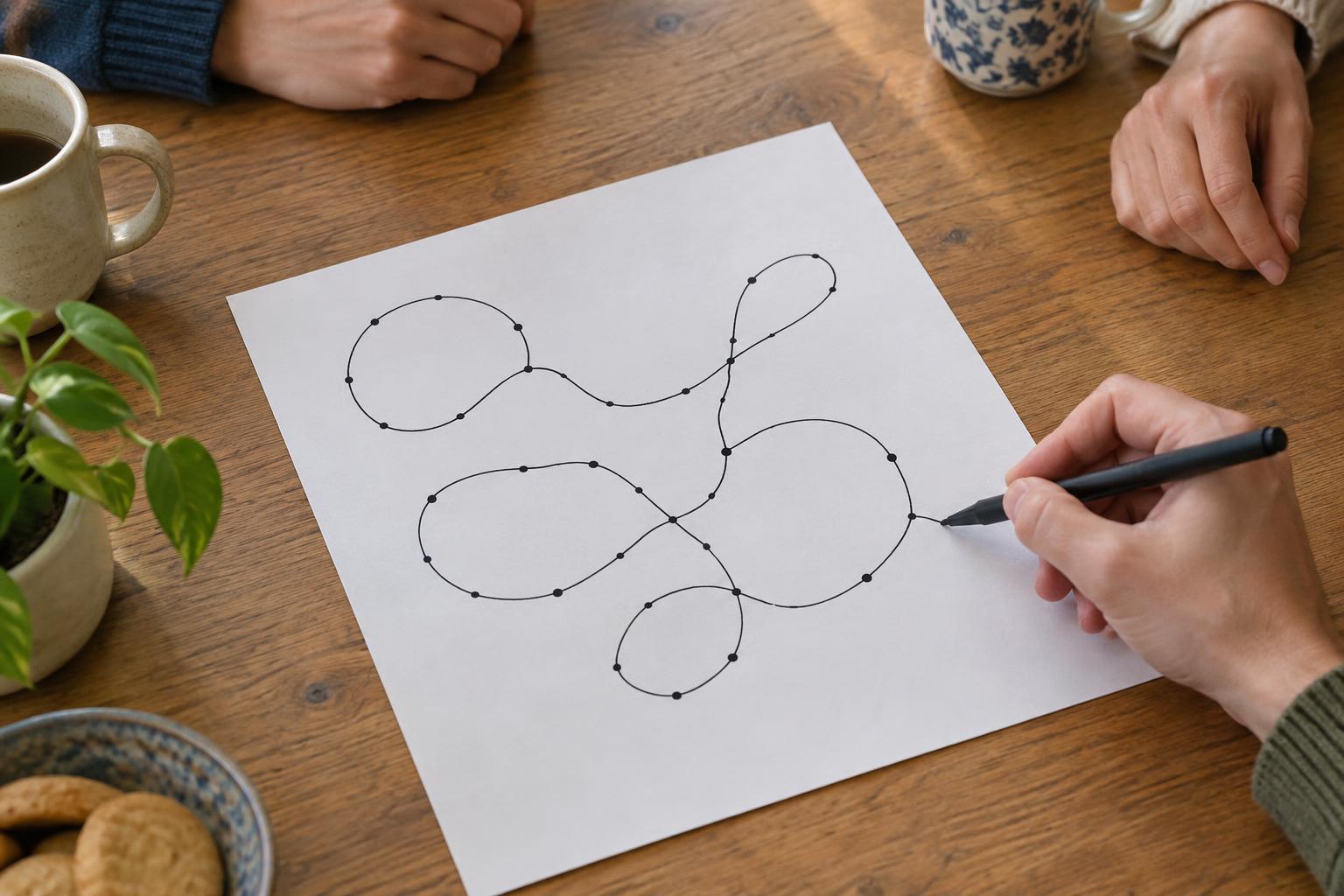
Sprouts is a two-player game that begins with three or four dots scattered across a sheet of paper. Players take turns connecting dots with lines. Each line gets a new dot placed somewhere along it, so the drawing grows more complicated with every move. The player who makes the last legal move wins.
You need a pen or pencil and enough blank paper to leave room around the starting dots. For a first game, place three dots several inches apart. Avoid putting them in a straight line or close to the edge: open space makes it easier to see where a new line could go. There is no grid or board to prepare, and turns need not be timed.
Make a legal move
On your turn, draw one continuous line from an existing dot to another existing dot. You may also draw a loop that starts and ends at the same dot. The line can curve, but it must not cross or touch another line, pass through a dot on its way, or cross itself. Once the line is drawn, put one new dot somewhere on that line, away from its ends.
Every dot can have no more than three line ends attached to it. A line joining two different dots uses one available attachment at each end. A loop uses two attachments at the dot where it starts and finishes. The new dot you place on a line already has the line entering and leaving it, so it has room for just one more attachment in a later turn.
Before drawing, count the attachments at your proposed endpoints and trace the route with your eyes. A dot with three attachments is full; it cannot be used as an endpoint again. Pencil can be forgiving for beginners, but agree before starting whether an accidental illegal line can be erased or whether the player must choose another move.
Look for routes, not just nearby dots
As the page fills, two dots may both have space for another attachment but still be impossible to connect. Existing lines can divide the drawing into separate areas. A new line must stay in open space from start to finish, without crossing a boundary. Dots that look close together may be on opposite sides of a loop, while a longer curved route may connect dots within the same open area.
You can sometimes connect a dot to itself even when no other dot is reachable. Check that the dot has room for the two attachments a loop requires and that there is enough clear space to draw it without crossing a line. When evaluating a possible move, also consider where its new dot will sit. Putting it in a cramped corner may leave little room for a future line; placing it along a wide arc can keep another route visible.
Sprouts rewards patient observation more than quick drawing. If you are unsure whether a route is open, pause and follow the surrounding lines with a finger without marking the paper. Taking a moment to check is easier than trying to interpret a messy crossing after it has been drawn.
Keep the drawing easy to read
Use smooth curves and leave a visible gap between lines that do not meet. Put each new dot clearly on its line, not beside it. If a line bends close to an older dot, make sure it does not appear to touch it. These small habits matter most late in the game, when a narrow passage might determine whether another turn is possible.
Before the first move, agree on a simple way to settle unclear marks. For example, both players can inspect a doubtful route before it is drawn and redraw a line immediately if its shape is ambiguous. When neither player can find a legal move, take one final look at the open areas together. If no move remains, the person who drew the last legal line wins.
Try a short game, then vary the setup
Three starting dots make a manageable introduction. Play once to learn the attachment limit, then switch who goes first and try again. Adding a fourth or fifth starting dot gives you more possible routes to inspect, but it can also make the finished drawing harder to read. Rather than rushing to a larger game, see whether you can explain why the final few moves are legal or blocked.
Sprouts fits easily into a quiet break because it needs no special equipment and leaves you with a record of your decisions. For a different kind of idea to explore after game time, browse Pomysły na biznes · Białystok Przedsiębiorczy.