Choose a space that suits the game
A backyard, open patch of park, or quiet grassy area can work for casual badminton. Look for level ground with enough room for players to move a few steps in every direction. Check for holes, slippery patches, low branches, and objects that someone might back into while watching the shuttlecock. Leave a generous gap from roads, water, other groups, and anything breakable.
Before setting out equipment, check whether games are allowed in the space and be ready to share it. If the area is busy, a compact game with shorter shots may be more considerate than one that sends players chasing across a path. Outdoors, wind matters more than precise dimensions: a sheltered spot is often more enjoyable than a larger, exposed one.
Gather the basics and mark simple boundaries
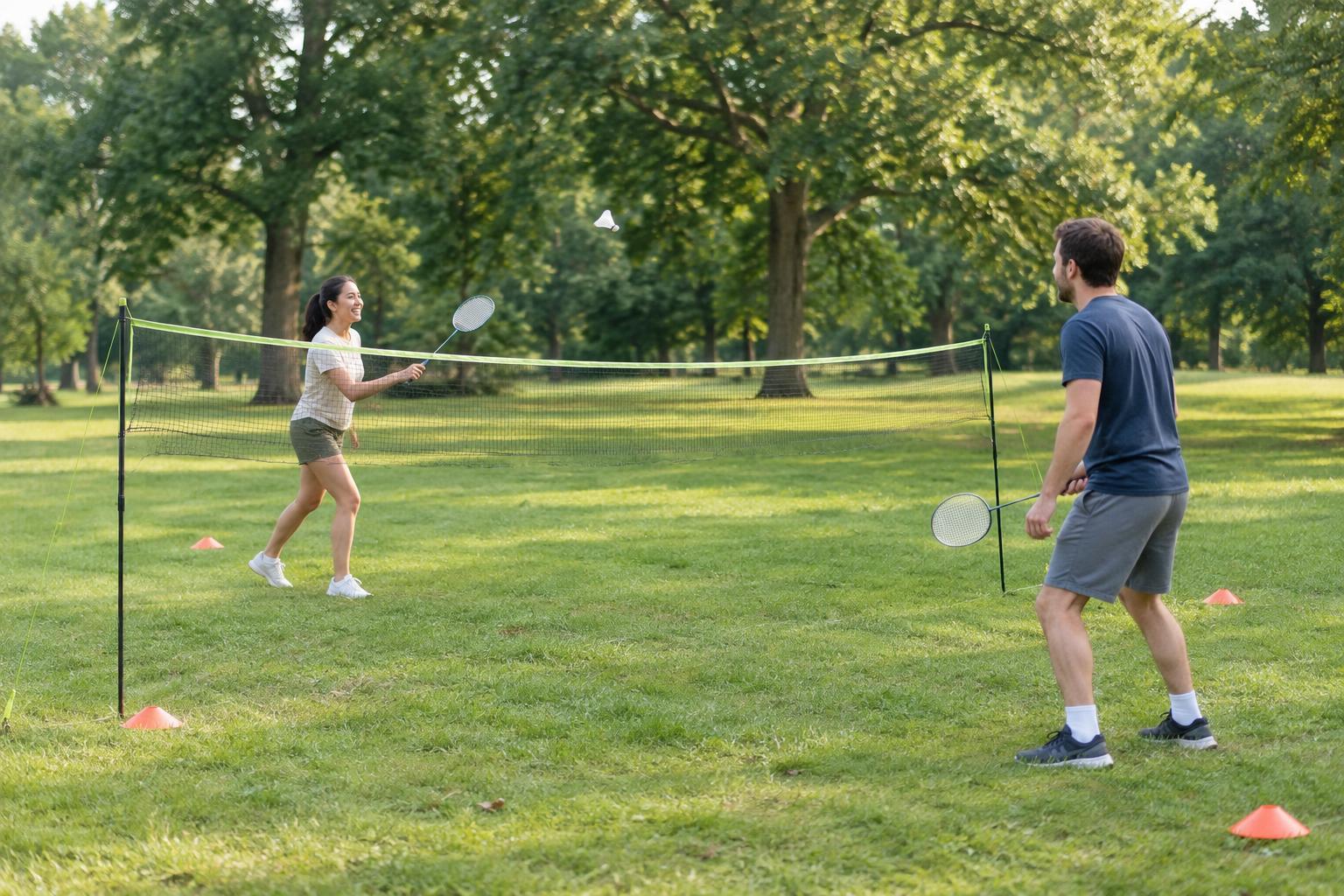
You need rackets and a few shuttlecocks. A spare shuttlecock is useful because one can easily land in long grass or become worn. Bring water and a small bag for your belongings and any litter. A portable net is helpful but optional; for a first game, an agreed imaginary line between two visible markers can separate the sides.
Make a rough rectangle using soft, visible markers such as spare clothing, cones, or small towels. Keep markers flat and away from where feet are likely to land. The space only needs to be wide enough for comfortable swings and long enough to make returning the shuttlecock interesting. If a rally repeatedly ends with someone running too far, bring the back boundaries closer.
If you use a portable net, follow its setup directions and place its supports where players will not collide with them. Avoid tying a cord across a public route or attaching equipment to trees or fixtures without permission. Without a net, agree that shots should travel over an imaginary line at about a comfortable racket-reaching height. Consistency matters more than getting the height exact.
Agree on rules before the first serve
For an easy start, serve from behind your side’s front marker and hit the shuttlecock toward the other side. A point ends when it lands inside the boundary, lands outside it, or is missed. Decide together whether the point winner serves next and whether a shot touching a boundary marker counts as in. Making these choices early prevents friendly uncertainty later.
Short games keep everyone involved. You might play to a score everyone agrees on, or rotate players after a set amount of time. For doubles, give each pair a moment to decide who covers which part of their side. If the space is narrow, take turns playing singles rather than crowding four people into it.
There is no need to enforce every formal badminton rule. If serving is difficult for a beginner, allow a second try. If a younger or less experienced player is joining, a gentle feed can start each rally. The goal is to create exchanges that feel fun, not to turn a patch of grass into a regulation court.
Adjust for wind and uneven rallies
A shuttlecock can drift or slow unexpectedly outdoors, so watch a few practice shots before settling on the boundaries. If one side has a noticeable advantage from the breeze, switch ends regularly. Try lower, controlled hits rather than relying on high shots that give the wind more time to change the shuttlecock’s path.
When the breeze makes scoring frustrating, turn the session into a cooperative challenge: count how many hits the group can manage before the shuttlecock touches the ground. You can also shorten the distance between sides or allow one bounce on grass if everyone wants a more forgiving game. These changes make it easier to keep playing without arguing over unpredictable shots.
Keep the setup easy to pack away
Give players room to warm up with a few gentle swings, and pause if the ground, weather, or nearby activity makes the game uncomfortable. Call out when a shuttlecock heads toward another person rather than chasing it blindly. Take breaks when needed, especially if the group has been moving more than expected.
At the end, count your rackets, shuttlecocks, and markers, and leave the area as you found it. A court-free game works best when setup and cleanup are simple: after one outing, you will know whether your group would enjoy adding a net, changing the size of the playing area, or keeping the next game just as informal.