Start with a spot you can visit easily
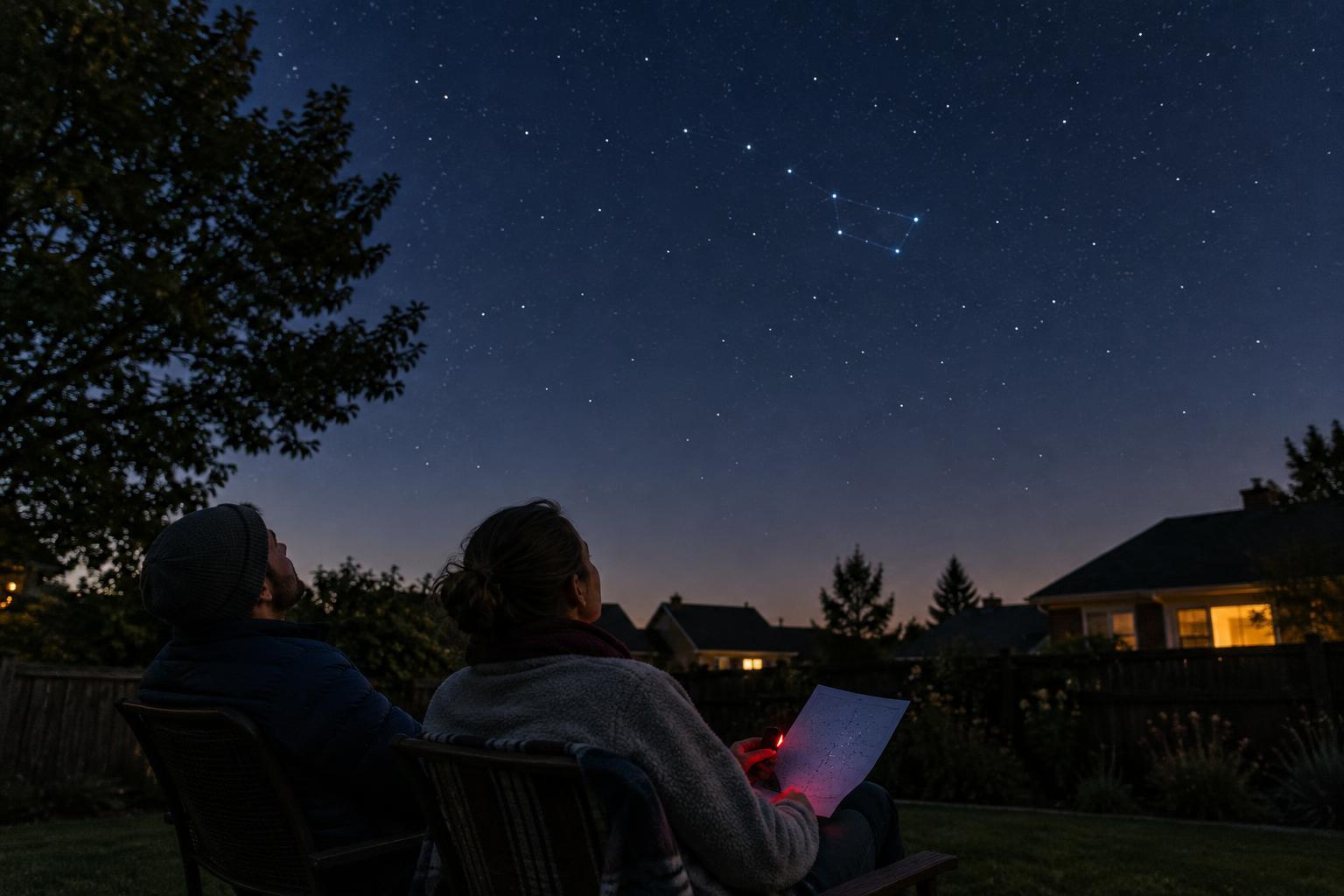
A backyard, shared courtyard or nearby open space is enough to begin. Choose a place where you can see a broad stretch of sky, even if houses and trees block part of the horizon. You do not need a perfect view in every direction: returning to the same spot makes it easier to notice how familiar patterns appear to move over time.
Turn off outdoor lights you control, and stand where porch lights and streetlamps are outside your direct view. Give your eyes time to adjust to the dark, and use a dim red light if you need to read a map or find your way around. On a clear night, a bright Moon can make faint stars harder to see, but it can also be an enjoyable target on its own. Check the weather before heading out, dress for the temperature and keep your route back indoors clear.
Use a map that matches your sky
Constellations do not appear in the same place at every hour or season, and which ones you can see depends on your location. A rotating paper star chart, often called a planisphere, or a sky-map app can help you identify what is above you. Set it for your approximate location, date and time. If you use a phone, dim the screen so it does not undo your eyes’ adjustment to the dark.
Begin by finding the cardinal directions. A compass can help, but you can also note where the Sun set earlier and use that as a rough guide to west. Hold your map so the direction you are facing is at the bottom; this makes it easier to compare the chart with the sky ahead. Treat the map as a guide rather than trying to match every star at once. Your view may show fewer stars than the chart, especially near city lights.
Learn one recognizable pattern at a time
Look first for an asterism: a memorable shape made by stars, which may be part of a larger constellation. In much of the Northern Hemisphere, the Big Dipper is a useful example when it is visible. Its seven prominent stars form a bowl and handle within the constellation Ursa Major. If you can see the bowl, imagine a line through the two stars on its outer edge and extend it away from the bowl. That line points roughly toward Polaris, the North Star. Polaris sits close to north in the sky, though buildings or trees may hide it.
Orion is another beginner-friendly pattern where and when it is visible. Look for three fairly bright stars in a short, nearly straight row: Orion’s Belt. Once you have found them, look for brighter stars around the belt that outline a broad hourglass shape. Do not worry if the drawing on a chart looks more elaborate than what you can pick out. Visibility changes with season, latitude, weather and local lighting; if neither pattern is up tonight, let your map suggest a different starting point.
Turn a quick look into a small project
Pick one pattern and sketch the stars you can actually see, including a roofline or tree for reference. You can label it after checking your map rather than interrupting every glance to confirm a name. On a later night, return to the same spot and compare your sketch. Stars appear to shift across the sky through the night, while the set of constellations visible at a convenient evening hour changes through the year.
If you are stargazing with friends, take turns describing a shape without naming it and see whether everyone can find the same stars. Give each person a few minutes to look before checking a map. This keeps the activity playful and helps you learn the sky instead of relying on a screen to identify everything for you. A chair, a warm drink and a short list of two or three targets can make the outing feel complete without turning it into a long expedition.
Build a habit, not an equipment collection
Your eyes are the main tool for learning constellations. Binoculars can be fun for exploring a small patch of sky later, but their narrow view is less helpful when you are first learning large patterns. Start with brief, repeatable sessions: find a landmark, identify one shape, and look for it again another night.
Some evenings will be cloudy or washed out by nearby lights. Rather than treating those conditions as failure, notice what remains visible and try a different time or viewing spot when you can. The reward of backyard stargazing is not seeing everything at once. It is becoming familiar enough with a small piece of sky that it starts to feel like part of your neighborhood.